
Teaching Philosophy

Cultivating Historical Consciousness through Interdisciplinary Pairings
In the humanities, students’ learning transcends mere historical knowledge acquisition; it encompasses understanding the myriad insights stemming from diverse values. My classroom reflects a core mission: a melding of cultures and academic backgrounds that resonate with the global multicultural tapestry we are part of.
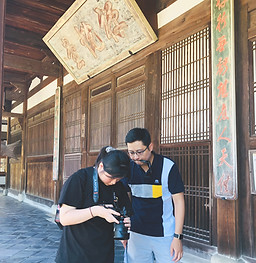
Bridging Historical Study with Real-World Relevance in Undergraduate Research
I firmly believe that students engage more deeply with academic material when they can directly relate it to their local community or cultural context. To realize this, I incorporate real-world relevance, striving to achieve common learning objectives that resonate across different academic disciplines.

Using Multimedia for for Enhanced Learning in Primary and Secondary Sources
In the current digital age, utilizing technology fosters student engagement and to deliver curriculum in more diverse, relatable, and dynamic ways. My extensive use of diverse cultural references — from movie, anime, meme, etc. — not only deepens the relatability of the material but ensures that students from various backgrounds can find resonance and enjoyment.
Click Here to access my full teaching philosophy
Teaching Demonstration
The following instructional demonstration is derived from the course The Worlds of Buddhism (EAS 160) I taught as a discussion instructor at the Department of East Asian Studies, The University of Arizona, during the Fall 2023 semester.
[Teaching Demo 1] Full Lecture on Buddhist Meditation
At a large lecture hall, I gave a 50-minute lecture on Buddhist meditation in both Indian and Chinese traditions.
[Teaching Demo 3] Introduction to Academic Writing
Guided students in writing their first academic papers and opportunities in collaborating with faculty research.
[Teaching Demo 2] Explaining Emptiness in Buddhism
This is a lecture in discussion session. I utilized multimedia for an enhanced learning experience.
[Teaching Demo 4] Leading a Discussion
Orchestrated small-group interactive discussion sessions.
Teaching Experience
Instructor
The Worlds of Buddhism (EAS 160)
Discussion Instructor, 2023
The University of Arizona, Department of East Asian Studies
-
Taught 1 individual lecture in large lecture hall with up to 70 attendees on the topic of "Buddhist Meditation."
-
Led three discussion sessions every week (15 weeks in total), each session had about 20 students.
-
Provided targeted feedback for each student’s individual progress, and encouraged students to integrate their professional skills with Buddhist studies.
-
Orchestrated small-group interactive discussions.
-
Guided students in writing academic papers.
-
Utilized multimedia for an enhanced learning experience.
Regarding my teaching experience in this course, please refer to the teaching demonstration provided above. -
Course total enrollment number: 106

I lead three discussion sections, instructing a total of 70 students.

I gave a 50-minute lecture about Chinese Buddhism in a large hall. Enrollment number: 106
I lead three discussion sections, instructing a total of 70 students.

.jpg)
English Speaking and Reading
Primary Instructor, 2017
Fo Guang University, Department of Buddhist Studies
-
Taught university students English speaking and reading skills to prepare them for job-seeking and civil service exams in Taiwan, attracting participation from students across various departments.
-
Employed a one-on-one conversational approach, supplemented by peer practice sessions.
Buddhist English
Section Instructor, 2016
Fo Guang University, Department of Buddhist Studies
-
Developed foundational courses aimed at enabling students to comprehend English-language Buddhist scholarly articles, catering to the department’s interest in advancing Buddhist studies.
-
Utilized small class sizes and group discussions as the primary teaching methods.
Taiwanese Religion, Culture, and Lifestyle
Primary Instructor, 2016
Nanhua University, Department of Tourism Management
-
Designed interactive courses on Taiwanese culture, local religions, and lifestyle habits, primarily utilizing situational simulations as the teaching method.
Teaching Assistant
Department of Religious Studies, The University of Arizona, 2019-2022
This video is a clip of the individual lecture I taught in the course "Gods, Goddesses, and Demons: Divinity in South Asia (RELI 160)" in large lecture halls with up to 200 attendees. I used video games as a pop-culture reference to explain the concept of devotion under religious context.

-
Taught 2 individual lectures
-
Facilitates student inquiries and discussions in large lecture halls with up to 200 attendees.
-
Introduced innovative teaching tools, designing assignments integrated with 3D views in Google to enhance visual learning.
Gods, Goddesses, and Demons: Divinity in South Asia (RELI 160)
Introduction to World Religions (RELI 160)
-
Broadened personal academic expertise, venturing beyond Buddhism to understand and teach diverse religious traditions.
-
Developed assessment rubrics to evaluate students’ understanding and engagement.
Religion, Violence, and Terrorism (RELI 235)
-
Integrated real-world incidents into the curriculum to foster a comprehensive understanding of religion's role in societal issues.
Yoga (RELI 367)
-
Facilitated online teaching, holding dedicated office hours for student queries and assignment mentoring.
Religion and Film (RELI 227)
-
Gained a novel approach to analyzing religion through the lens of film studies, enhancing curriculum delivery.
-
Organized film viewings and coordinated discussions to foster critical thinking among students.